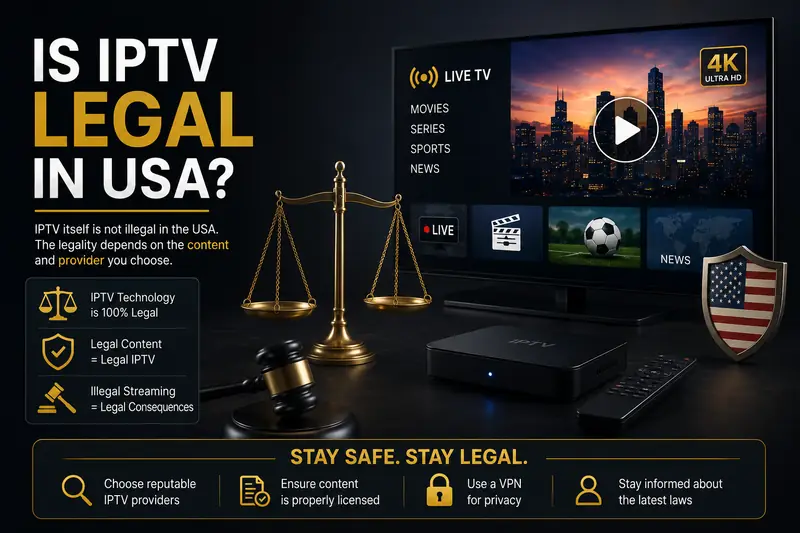
Let's clear up the question that stops a lot of cord-cutters cold: yes, IPTV is legal in the USA. The technology that delivers TV over the internet is the exact same one powering YouTube TV, Hulu Live and Sling. What actually decides legality isn't IPTV itself — it's whether the service has the rights to the content it streams.
That distinction matters more than ever. Visits to illegal streaming sites jumped from 130 billion in 2020 to about 216 billion in 2024 — a 66% rise — and roughly 9 million US broadband homes now pay for some form of unlicensed IPTV. Regulators have noticed, and enforcement has sharpened.
So where does that leave you, the viewer who just wants sports without a $147 cable bill? In a much safer spot than the headlines suggest. This guide explains what the law really says, who it targets, and how to enjoy IPTV on the right side of it.
- IPTV is legal technology. YouTube TV, Hulu Live and Sling are all IPTV — legality hinges on content licensing, not the delivery method.
- Player apps like IPTV Smarters Pro and TiviMate are 100% legal — neutral tools, like a web browser.
- The Protecting Lawful Streaming Act of 2020 targets commercial piracy operators (up to 10 years), and explicitly does not target individual viewers (USPTO, 2020).
- US enforcement focuses on sellers and operators, not home viewers — but choosing a legitimate, transparent service is the safe play.
Want a Service That Plays It Straight?
Transparent plans, real support, instant setup. Try 25,000+ live channels free for 24 hours — no card required.
Start Free TrialIs IPTV legal in the USA?
Yes — IPTV is legal in the USA. IPTV simply means "Internet Protocol Television," a method of delivering video over the internet instead of cable or satellite. Some of the biggest, most mainstream services in America are IPTV at their core, including YouTube TV, Hulu + Live TV, Sling and DirecTV Stream. The technology has never been the problem.
The legal line is drawn around content rights. A service is operating legally when it has licensing agreements to distribute the channels and shows it offers. It crosses into piracy when it streams that content without permission. Same technology, completely different legal footing — and that's the whole question in a nutshell.
Think of it like a car. A car is legal. How someone drives it decides whether a law gets broken. IPTV works the same way: the pipe is lawful, and what flows through it is what counts.
Legal vs. illegal IPTV: what's the actual difference?
The difference comes down to one word: licensing. A legal IPTV provider pays for the rights to distribute content; an illegal one doesn't. Around 9 million US broadband subscribers currently pay for unlicensed IPTV, often drawn by prices that legitimate licensing simply can't match (Help Net Security, 2025).
Legitimate services behave like real businesses. They have a registered company, clear terms of service, published pricing, working customer support, and content delivered through proper channels. Unlicensed operations tend to hide ownership, dodge taxes, and vanish without warning when enforcement closes in.
For cord-cutters, the practical takeaway is simple. You don't need to fear the letters "IPTV." You need to look at the provider behind them, the same way you'd vet any subscription. Our guide to a reliable IPTV service walks through the business signals worth checking.
What does US law actually say about IPTV?
US law doesn't ban IPTV; it bans copyright infringement — and it aims that ban squarely at commercial operators. The key statute is the Protecting Lawful Streaming Act of 2020, signed in December 2020, which made large-scale, for-profit unauthorized streaming a felony punishable by up to 10 years for repeat offenders (USPTO, 2020).
Here's the part that reassures most viewers. The law was written narrowly. According to the bill's own framing, it applies only to commercial piracy services and will not "impact individuals who access pirated streams." It closed a loophole that had let illegal streaming operators off lighter than people selling bootleg discs.
In plain terms: the felony exposure created by federal streaming law lands on the businesses running unlicensed services for profit — not on a family watching at home.
Older tools still apply too. The Digital Millennium Copyright Act (DMCA) lets rights-holders demand takedowns of infringing streams, which is why pirate services play whack-a-mole with domains. If you ever need to flag content here, our DMCA policy explains the process. Civil copyright law, meanwhile, gives studios and leagues the right to sue infringers directly.
Can you get in trouble for watching IPTV?
For the vast majority of US viewers, the honest answer is that enforcement targets operators and sellers, not individual watchers. Federal streaming law was built to prosecute the people running for-profit piracy services. Authorities and rights groups have focused their firepower there — shutting down networks and winning multimillion-dollar judgments against operators.
That said, it pays to be straight with you: this isn't a guarantee, and the climate is tightening. In the last couple of years some rights coalitions have started sending settlement-demand letters to a small number of home users of unlicensed services. The risk to any one viewer stays low, but "low" isn't "zero." Why gamble at all when a legitimate service costs less than a couple of coffees a month?
The clean way to remove the worry entirely is to choose a service that operates transparently and to understand your responsibilities where you live. That's not just our advice — it's the principle behind our own terms of service.
How to use IPTV legally and safely
Using IPTV legally is mostly about choosing well and using common sense. Since the median US home already has about 289 Mbps of broadband — over 11x the 25 Mbps a 4K stream needs (Ookla, 2025) — you have every technical reason to cut cable. The goal is doing it through a provider that behaves like a real, accountable business.
- Favor transparency. A real company name, published terms and privacy policy, and clear contact details.
- Look for proper pricing. Honest plans you can review on a pricing page — not a price that's impossible for full premium TV.
- Demand real support. Live help on WhatsApp or Telegram beats a dead contact form.
- Test before you pay. A genuine free trial lets you verify the service first-hand.
- Know your local rules. You're responsible for ensuring your use complies with the laws in your state and country.
Do those five things and you've handled the legal and practical side at once. For the broader picture of how IPTV stacks up against your other options, see our breakdown of the best alternatives to cable.
Are IPTV apps like IPTV Smarters Pro legal?
Yes — IPTV player apps are completely legal. Apps like IPTV Smarters Pro, TiviMate and Smart IPTV are neutral tools that play a video stream you give them, much like a web browser loads a website or VLC plays a file. The app has no content of its own and breaks no law by existing.
This is why you'll find many of these players right in the official Apple App Store and Google Play Store. What determines legality is the service you load into the app — the subscription and playlist behind it. The player is just the screen. Our guide to IPTV Smarters Pro covers how to download and set it up.
So if you've worried that installing a popular IPTV app puts you at risk — it doesn't. Pair a legal app with a legitimate, licensed service and you're on solid ground from the screen all the way back to the source.
Is IPTV Smarters Plus legal to use?
IPTV Smarters Plus operates as a transparent subscription service: published plans, a real free trial, 24/7 support, and clear terms of service and privacy policy. We provide technical access to internet-delivered media through legal player apps, and we're upfront about how the service works.
As our site-wide disclaimer states, users are responsible for ensuring their use complies with all applicable laws and regulations in their jurisdiction. We're not a piracy operation hiding in the shadows — we're a documented business you can reach, question, and try before paying. If you have a compliance question, just contact our team.
The smartest way to judge any service, ours included, is to test it. Start the free trial, review the pricing, and see the 4K quality for yourself before you commit a dollar.
Try a Service You Can Actually Vet
Transparent plans, real support, instant activation. Stream 25,000+ live channels free for 24 hours — no card needed.
Start Your Free TrialFrequently Asked Questions
Is IPTV legal in the USA?
Yes. IPTV — delivering television over the internet — is a legal technology, the same one YouTube TV, Hulu Live and Sling use. Legality depends on whether the service holds the rights to the content it streams. Licensed services and the player apps themselves are fully legal.
Can you get in trouble for watching IPTV?
US enforcement focuses on commercial operators who sell unlicensed streams, not individual viewers. The Protecting Lawful Streaming Act of 2020 explicitly does not target people who access streams; it makes large-scale, for-profit unauthorized streaming a felony for the operators behind it.
Are IPTV apps like IPTV Smarters Pro legal?
Yes. IPTV Smarters Pro, TiviMate and Smart IPTV are neutral player apps — like a browser or media player. The app itself is completely legal. The service and playlist you load into it determine whether your use is properly licensed.
What did the Protecting Lawful Streaming Act change?
Signed in December 2020, it closed a loophole by making large-scale commercial streaming piracy a felony, matching the penalties for illegal downloads — up to 10 years for repeat operators. It applies only to for-profit piracy services, not noncommercial users (USPTO, 2020).
How do I know if an IPTV service is legal?
Look for legitimate-business signals: a clear company and terms of service, transparent pricing, real customer support, and a free trial. Content delivered openly through proper channels is a good sign. Prices that seem impossible for full premium channel lineups are the biggest red flag.
The bottom line
Is IPTV legal in the USA? The technology absolutely is — and so are the apps that play it. The only question that matters is whether the service behind the stream is licensed and legitimate. US law backs that up: it targets the for-profit operators running piracy, not the family watching the game at home.
So choose like a grown-up subscriber. Pick a transparent provider, use a legal app, and know your local rules. Do that and cord-cutting is a clear win over a $1,700-a-year cable bill. The easiest first step is to start a free trial and see a legitimate IPTV service work for yourself.
This article is general information, not legal advice. Laws vary by state and country — if you're unsure about your situation, consult a qualified attorney.
Sources
- USPTO, "Protecting Lawful Streaming Act of 2020," retrieved 2026-06-24, uspto.gov
- Copyright Alliance, "Protecting Lawful Streaming Act Signed Into Law," 2021, retrieved 2026-06-24, copyrightalliance.org
- Help Net Security, "Illegal streaming grew into an organized, profitable, and dangerous industry," December 2025, retrieved 2026-06-24, helpnetsecurity.com
- Ookla Speedtest (US median fixed broadband, May 2025), retrieved 2026-06-24, allconnect.com/blog/us-internet-speeds-globally
- Cord Cutters News, "Average Cost of Cable TV Climbs to Over $147 a Month," 2025, retrieved 2026-06-24, cordcuttersnews.com
Comments are loading… Be the first to share your experience below.