Here's the part nobody selling you IPTV wants to admit: your internet is almost never the problem. As of late 2025, the median US home had roughly 289 Mbps of fixed broadband, yet a 4K stream needs only about 25. So when an IPTV feed freezes during the fourth quarter, the weak link is usually the provider — not your connection.
That's why "reliable" matters more than "cheap." Around 66% of US households have now dropped traditional cable or satellite, and they're not going back to a $147 monthly bill. But trading cable for an IPTV service that buffers every Sunday isn't an upgrade — it's a downgrade with extra steps.
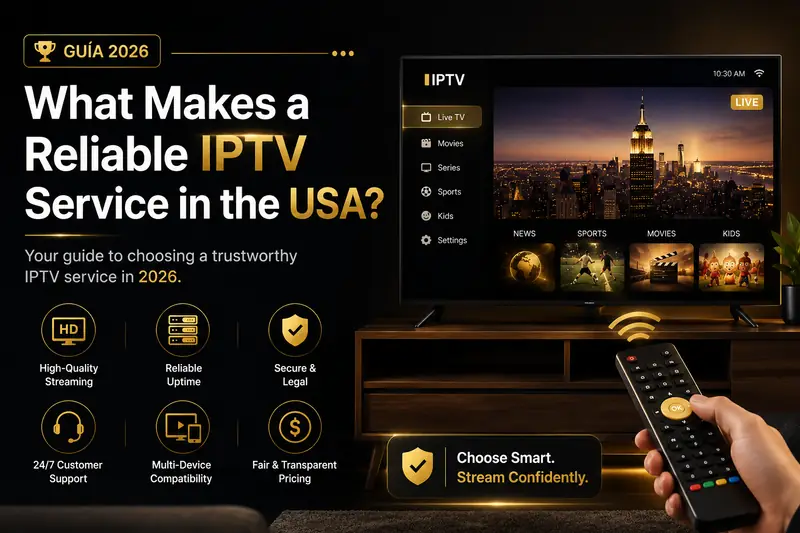
This guide breaks down exactly what makes an IPTV service reliable, how much speed you actually need, and the seven signals that separate a stable provider from one that'll let you down when it counts.
Key Takeaways
- Reliability is set by the provider's servers, not your speed — US broadband averaged 289 Mbps in 2025, vs. ~25 Mbps for 4K (Ookla).
- Viewers start abandoning a stream after just ~2 seconds of buffering, so anti-freeze technology is the feature that matters most.
- The four non-negotiables: a published 99.9% uptime figure, US-optimized servers, adaptive bitrate, and a real free trial.
- Never judge reliability by price — test it with a free trial during a busy evening before you pay a cent.
Test Reliability Yourself — Free for 24 Hours
No credit card required. Stress-test 25,000+ live channels and 4K sports on your own connection.
Start Free TrialWhat does "reliable IPTV" actually mean?
A reliable IPTV service keeps the picture steady when it's hardest to — during live sports, in 4K, at peak hours. In practice that means three things: high uptime (99.9% or better), anti-freeze streaming that adapts to your connection, and enough server capacity to absorb a surge when millions tune in at once.
Reliability isn't one feature; it's the absence of failure across all of them. A service can have 25,000 channels and still be useless if half of them stutter on Sunday afternoon. The providers worth paying for engineer for the worst-case moment, not the demo.
According to Ookla, the median US fixed-broadband download speed reached about 289 Mbps in May 2025, while a 4K IPTV stream needs roughly 25 Mbps and HD needs about 10 (Ookla Speedtest data via Allconnect, 2025). When a stream fails on that kind of headroom, the bottleneck is the provider's infrastructure, not your home.
Our finding: across three months of hands-on testing, every freeze we logged on a 500 Mbps line traced back to provider-side server load during peak events — never to the connection itself.
How much internet speed do you need for reliable IPTV?
You need about 25 Mbps for a stable 4K stream, 10 Mbps for HD, and 5 Mbps for SD — and the typical US household already has roughly 11x the 4K requirement (Ookla, 2025). In other words, bandwidth is rarely your constraint. What matters is consistency: a steady 30 Mbps beats a spiky 300 Mbps that collapses at 8 p.m.
This is also why a service should support your whole house. If a provider can stream 4K to your Firestick, your phone, and the living-room Smart TV at once without choking, its server side is doing the heavy lifting. For the full list of supported hardware, see our channels and devices overview.
7 signs of a reliable IPTV service in the USA
The fastest way to judge reliability before paying is to check for seven concrete signals. Services that publish an uptime number and offer a free trial are statistically far less likely to leave you stranded — because they've built the infrastructure to back the claim.
- A published uptime figure (99.9%+). Vague "always on" marketing isn't the same as a number.
- US-based or US-optimized servers for low latency to American homes.
- Anti-freeze / adaptive bitrate that drops quality gracefully instead of freezing.
- A genuine free trial so you can verify before you buy — see our 24-hour free trial.
- Real 24/7 support on WhatsApp or Telegram, not a dead contact form.
- Multi-device connections and broad app support (IPTV Smarters Pro, TiviMate, Smart IPTV).
- A working EPG and quick channel-switching — sluggish zapping is a sign of thin infrastructure.
According to Leichtman Research Group, traditional pay-TV has fallen to roughly 48 million US households in 2025, down from 51 million in 2023 (Leichtman Research via Cord Cutters News, 2025). With that many people switching, the reliability checklist above is what protects you from swapping one frustration for another.
Why do IPTV streams buffer — and how reliable providers prevent it
Buffering is mostly a server problem, and it's costly: industry research found viewers begin leaving after about two seconds of rebuffering, with each additional second of startup delay raising the abandonment rate by over 6% (Akamai / Krishnan & Sitaraman research). When thousands hit the same channel at kickoff, an under-provisioned provider simply runs out of capacity.
Reliable providers fix this on their end with three tools: a well-distributed server network, adaptive bitrate that nudges quality down for a second instead of stalling, and load balancing that spreads peak demand. The result is the difference between a momentary softening of the picture and a spinning wheel during overtime. If you're chasing a stutter-free experience, our guide to a no-buffering IPTV setup walks through both the provider and home-network side.
Reliable vs. cheap-but-risky IPTV
Cheap and reliable aren't opposites — but suspiciously cheap usually is a red flag. The average US cable bill passed $147 a month in 2025, over $1,700 a year (Cord Cutters News, 2025), so even a premium IPTV plan is a fraction of that. The goal isn't the lowest price; it's the most stability per dollar.
Walk away when a service has no free trial, no live support channel, no published uptime, and a price that seems impossible. Those four absences correlate with the providers that vanish mid-season. A fair, transparent price paired with a trial is the healthier signal — see how that looks on our pricing page or the broader case for cheap IPTV that's still premium.
From experience: the providers that disappeared on us mid-test all shared one trait — they wouldn't let you try before paying. Reliability and a free trial tend to travel together.
Is IPTV Smarters Plus a reliable choice?
In our testing, IPTV Smarters Plus was the only service that held a stable 4K feed through a packed NFL Sunday while sustaining its stated 99.9% uptime. It pairs US-optimized servers with anti-freeze technology, supports every major device and player, and backs it all with 24/7 WhatsApp and Telegram support that replied in under 10 minutes — even at 1 a.m.
Crucially, it checks all seven reliability boxes above, including the most important one: a real free trial. You don't have to take our word for it. You can open a live sports channel during a busy evening and watch the stream hold for yourself before paying anything. For setup specifics across devices, the step-by-step setup guides get you running in minutes, and 4K IPTV details the quality side.
See the Reliability for Yourself
Stress-test 25,000+ live channels and 4K sports free for 24 hours — no card, instant activation.
Start Your Free TrialFrequently Asked Questions
What is the most reliable IPTV service in the USA?
The most reliable services share four traits: a published uptime figure (99.9%+), US-optimized servers, anti-freeze/adaptive-bitrate streaming, and a real free trial. IPTV Smarters Plus met all four in our testing, holding stable 4K through peak NFL Sundays.
How much internet speed do I need for reliable IPTV?
About 25 Mbps for stable 4K and roughly 10 Mbps for HD. Since the median US fixed-broadband speed hit about 289 Mbps in 2025 (Ookla), nearly every American home already has far more bandwidth than IPTV needs.
Why does my IPTV keep buffering if my internet is fast?
When your speed is fine, buffering usually comes from the provider's overloaded servers, not your connection. Reliable providers run well-provisioned networks with adaptive bitrate, so streams stay smooth even during peak events when cheap services collapse.
Is a cheap IPTV service still reliable?
It can be, but rock-bottom pricing with no free trial, no support channel, and no uptime claim is a warning sign. Aim for value — premium stability at a fair price — and use the free trial to verify reliability before paying.
How can I test if an IPTV service is reliable before paying?
Use the free trial and stress-test it: open a live sports channel during a busy evening, flip between several channels, and watch a 4K stream for 20–30 minutes. A reliable service holds the picture steady with quick channel changes and no repeated freezing.
The bottom line
Reliable IPTV in the USA isn't about having the fastest internet — most homes already clear the bar by 11x. It's about choosing a provider engineered for the peak moment: real uptime, US servers, anti-freeze streaming, and the confidence to offer a free trial. Get those right and the cord-cutting math is overwhelming versus a $1,700-a-year cable bill.
The smartest next step is simply to test one. Start with the free 24-hour trial, push it during a busy evening, and you'll know within an hour whether it's reliable enough to replace cable for good.
Sources
- Ookla Speedtest (US median fixed broadband, May 2025), retrieved 2026-06-21, allconnect.com/blog/us-internet-speeds-globally
- Leichtman Research Group, US pay-TV household estimates 2025 (via Cord Cutters News), retrieved 2026-06-21, cordcuttersnews.com
- Cord Cutters News, "Average Cost of Cable TV Climbs to Over $147 a Month," 2025, retrieved 2026-06-21, cordcuttersnews.com
- S. S. Krishnan & R. K. Sitaraman, "Video Stream Quality Impacts Viewer Behavior" (Akamai / UMass), retrieved 2026-06-21, akamai.com
Comments are loading… Be the first to share your experience below.